Table of Contents
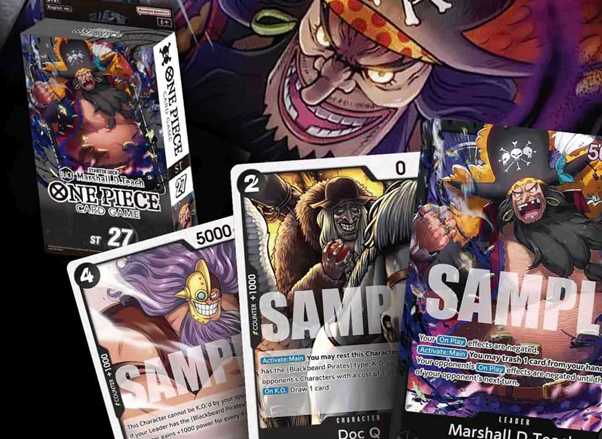
Blackbeard is one of those matchups that exposes the difference between players who understand their deck deeply and players who are still running on autopilot. Generic advice — attack aggressively, manage your hand, apply pressure — doesn't cut it here. Teach's kit is specifically designed to punish standard lines of play, and the decks that beat him consistently tend to do so through strategies that are built around their own win conditions rather than just reacting to what he's doing.
This article focuses on practical, deck-specific approaches to the Blackbeard matchup, starting with Red Purple Luffy and Robin — two decks that interact with his kit in very different ways — and opening the conversation to broader strategic principles that apply across the meta.
Why Blackbeard Is Such a Problem
Before getting into specific counters, it's worth understanding exactly what makes Teach so difficult to deal with. His blocker — the 10-cost version — is the centrepiece of the problem. As long as your opponent has life remaining, that card sits on the board and blocks almost anything you throw at it. It doesn't just slow your attacks down; it makes your entire offence feel like it's hitting a wall that regenerates every time you think you've made progress.
The second issue is hand disruption. Blackbeard's kit chips away at your resources over time, and decks that rely on holding cards for late-game plays — Robin being a prime example — feel that pressure acutely. By the time you're ready to set up your board, you may not have the cards to do it properly.
The matchup, at its core, comes down to one question: can you get your opponent to zero life before the 10-cost Teach becomes an unmovable object? If the answer is yes, that blocker suddenly becomes irrelevant. If the answer is no, you need a different plan.
Red Purple Luffy: Using Speed as the Solution
Much like the calculated risk-takers who research their options thoroughly before committing at Winbeast Casino and enjoying the Winbeast Casino bonus, the best RP Luffy pilots approach the Blackbeard matchup with a clear plan rather than improvising turn by turn. The core insight here is straightforward: Luffy's late game is impressive, but against Blackbeard it's the early and mid game that decides everything.
The key adjustment is building aggression into the deck through fast-attack units that can apply meaningful pressure before Teach's defensive pieces are fully online. Shanks and Roger at 10-cost are the linchpin cards here, but making them work requires board setup. If you can get Kid onto the field before playing either of them, the math changes significantly — you can drop a 10-cost unit and still have Don in reserve for Gum-Gum Giant, which means your pressure spike hits harder and leaves your opponent with genuinely uncomfortable choices.
Roger in particular can be a game-deciding card in this matchup. Once your opponent reaches zero life — or once you can push them there quickly — the 10-cost Teach loses his blocker status. That's the window Roger is built to exploit. The whole strategic question becomes: how do I get my opponent to zero life fast enough that Roger turns their best defensive piece into a liability?
The trade-off most players are reluctant to make is cutting some 9-cost Luffys to make room for these pieces. It feels wrong because Luffy is the Leader and those cards are powerful. But in this specific matchup, a 9-cost Luffy who triggers in the mid-game is still just a quick-attack unit — useful, but not the same kind of pressure as a board where Roger is threatening to close the game entirely. The concession is worth it when the matchup demands it.
The broader principle: RP Luffy against Blackbeard should be played faster and more aggressively than your default line. Resist the urge to set up the ideal late-game board. Commit to the race and build your deck to win it.
Robin: A Harder Problem Without a Clean Solution
Robin is the matchup where honest players admit they haven't fully solved it yet — and that's a reasonable place to be. The deck's natural game plan leans toward a mid-to-late game build-up: deploy Yamato, Big Mom, and similar high-impact pieces once the board foundation is in place. Against most opponents that works well. Against Blackbeard, who is actively stripping your hand and making the setup window shorter, it runs into problems.
The best approach found so far — and it's imperfect — is aggressive early play that prioritises face attacks using excess Don, combined with hand-pressure tactics through banishment effects. The goal is to drain Blackbeard's hand before you start deploying your heavy pieces, rather than developing your board first and hoping to survive the disruption.
The logic is sound: a Blackbeard player with no cards in hand can't respond effectively to Yamato or Big Mom landing on the board. The problem is execution. Going face-aggressive with Robin feels unnatural because the deck isn't built around that game plan, and you're often sacrificing board development to do it. It works often enough to be the right approach but doesn't feel clean the way the RP Luffy solution does.
What Robin needs is a deck-specific technique that converts its existing toolkit into a consistent Blackbeard counter — something equivalent to the Kid-plus-Shanks-or-Roger combination that RP Luffy has available. That technique hasn't been fully identified yet, and it's the kind of thing that gets solved through community experimentation rather than theory alone.
If you're piloting Robin into this matchup regularly, the working framework is: play faster than the deck wants to play, prioritise hand depletion over board development in the early turns, and accept that you'll need to adjust the timing of your big plays based on the state of the opponent's hand rather than a fixed turn sequence.
The General Principle: Blackbeard Demands Deck-Specific Answers
What makes this matchup genuinely interesting from a strategic standpoint is that there probably isn't a universal counter that works across all decks. Generic advice — apply early pressure, don't let the blocker settle, attack the hand — is true but insufficient. Each deck has its own tools and its own limitations, and the solutions that emerge tend to be specific to what those tools can do.
Decks with access to Rush units and high-power finishers have the clearest path: race to zero life and make the 10-cost Teach irrelevant before he defines the game. Decks that rely on board development and resource accumulation need to find ways to compress that game plan into fewer turns than they'd prefer, or identify ways to disrupt Blackbeard's setup before it becomes a problem.
The Nami comparison is instructive. Against certain dominant decks, the matchup forces you to play differently — not just to execute your plan better, but to fundamentally reconsider which parts of your plan are viable. Decks that have identified that pivot point clearly are the ones posting consistent results against Blackbeard. Decks still trying to play their standard game into his kit are the ones getting frustrated by the wall.
What to Look For in Your Own Deck
If you're working through this matchup with a deck not covered above, the questions worth asking are specific: does your deck have a way to spike pressure before turn five or six? Do you have units that apply meaningful offensive power without relying on the kind of card accumulation Teach's disruption targets? Is there a combination of cards in your list that changes the math the way Kid plus Roger does for RP Luffy?
The decks that have found clean answers to Blackbeard tend to have identified a two or three card sequence that either bypasses his blocker, depletes his hand faster than he can use it, or creates a board state where the 10-cost Teach landing doesn't matter because the game is already effectively over.
Find that sequence in your deck. Build toward it deliberately. And accept that what works against every other matchup may need to be adjusted specifically for this one — because Blackbeard is the kind of threat that rewards preparation and punishes assumptions.