Table of Contents
There's a debate that never gets old in the One Piece community — and it lives just as comfortably in the card game as it does in the anime powerscaling forums. It goes something like this: how is that character beating that character? How does someone who seemed like mid-tier cannon fodder in the source material end up being an absolute menace on the tabletop? How do characters who were canonically outclassed, defeated, or simply never regarded as elite somehow dominate the most competitive tables in the game?
It's a question that gets funnier the deeper you go. And in the One Piece Card Game, it happens constantly — and gloriously.
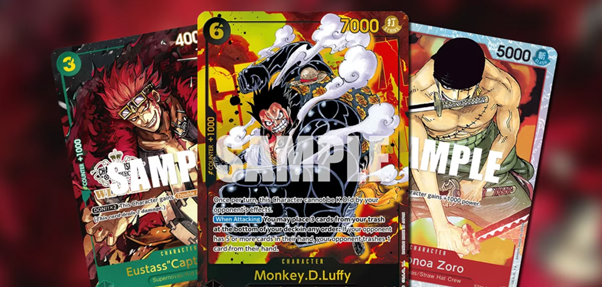
When the Card Is Better Than the Character
One of the most entertaining tensions in any anime-based card game is the gap between a character's narrative standing and their mechanical power on the table. In the anime and manga, the hierarchy of strength is something fans track obsessively. Who could beat who. Who has the higher ceiling. Whose Haki is more refined. It's the kind of discussion that fills entire threads, spawns hour-long YouTube videos, and causes genuine arguments between people who should probably be friends.
The One Piece Card Game, developed by Bandai, leans into this beautifully — sometimes to the frustration of fans who feel their favourite top-tier Yonko is being outclassed by someone who got knocked out in three panels of the manga.
The reason this happens is actually quite thoughtful game design. Bandai doesn't simply translate raw narrative power into card stats. They translate personality, role, and story function — which means a schemer, a support character, or a villain who existed mostly as a plot device can be mechanically brilliant in ways that a straightforward powerhouse simply isn't built to be. A character whose entire identity is manipulation, misdirection, or resource control translates those traits into clever card effects. Meanwhile, a character defined purely by hitting very hard sometimes ends up as a big number on an otherwise straightforward stat block — a design philosophy that interestingly mirrors systems you might encounter in places like Reveryplay, where strategic depth often matters more than surface-level strength.
This design philosophy is a feature, not a bug. It keeps the game interesting. It rewards players who look beyond surface-level popularity and actually understand how mechanics interact. And it means that every new set has the potential to completely rehabilitate a character who never got their due in the source material.
Baroque Works and the Revenge of the Forgotten
Take Baroque Works as a case study. In the story, this criminal organisation was thoroughly dismantled by the Straw Hats during the Alabasta arc — a relatively early chapter in Luffy's journey. Their agents, for all their personal drama and memorable designs, were not exactly the pinnacle of One Piece's power hierarchy. Sir Crocodile himself, the organisation's leader, is a character that fans have been arguing about for years in terms of where exactly he fits in the broader power scaling conversation.
And yet, in the card game, the Baroque Works archetype has genuine mechanical teeth. Crocodile's card effects create layered interactions that reward patient, deliberate play. Miss All Sunday enables cheating out multiple characters directly from the trash, creating board states that feel genuinely oppressive when executed correctly. Miss Doublefinger gains serious power boosts under the right conditions. The deck rewards players who understand resource management, who think two or three turns ahead, and who can build toward a payoff without telegraphing the game plan too early.
Suddenly, characters who lost to pre-timeskip Luffy are running competitive tables. The community reacts with a mix of delight and visible irritation depending entirely on which side of the matchup they're on. This is the One Piece Card Game working exactly as intended.
The OP-15 Skypiea Shake-Up
The most recent major set to hit the Japanese market brings all of these themes into sharp focus. OP-15, titled "Adventure on the Island of God," released in Japan in February 2026, with the Skypiea arc as its central theme. A new Purple Enel Leader and long-awaited support for Yellow Calgara have sent the community into an excited frenzy, and early tournament results have already started to validate the hype.
And here is where the powerscaling debate gets truly delicious.
Enel — also known as Eneru in the original Japanese — is one of the most discussed characters in One Piece's long history of fan debate. On one hand, he possesses a Devil Fruit ability that should make him nearly untouchable: the ability to transform into and control lightning, combined with an observation Haki so refined that he could anticipate almost any attack before it landed. He ruled Skypiea as an absolute authority. His power level in conventional terms was, by any reasonable measure, extraordinary.
On the other hand, he was beaten by Luffy — a man made of rubber. Canonically, this is explained well enough. Rubber doesn't conduct electricity. Luffy is Enel's natural counter. The fight itself is played partly for comedy, with Enel's expression of complete disbelief becoming one of the most meme'd images in the entire franchise.
The community has never quite let Enel live it down. The debates about where he actually sits in the power hierarchy, how he would fare against other characters, what his true ceiling is — these conversations are ongoing and frequently heated.
In the card game, none of that matters. Purple Enel has performed strongly in early OP-15 tournaments, establishing himself as a genuine top-tier threat and offering a potential shift away from the decks that dominated the previous competitive season. The god of lightning, mocked for decades for his single most famous defeat, gets his revenge not in the skies above Skypiea but on tournament tables around the world.
There is something deeply satisfying about this if you approach it in the right spirit.
Reading the Meta Like a Log Pose
Part of the skill of playing the One Piece Card Game at a competitive level is learning to read the meta the way a navigator reads a Log Pose — not just knowing where you are, but anticipating where the current will take you next. The game's meta shifts with each new set, and the players who succeed consistently are those who invest time in understanding not just their own deck but the broader landscape they're operating in.
The OP-13 meta offers a useful lesson here. Black Imu emerged as a dominant force, commanding an extraordinary share of top cut results across major tournaments. The strategy revolved around stalling early with Celestial Dragons, assembling the right combination of Five Elders cards for immunity, and then transitioning into an aggressive late game backed by powerful blockers. On paper, describing it that way makes it sound almost manageable. In practice, sitting across from a well-piloted Black Imu deck was a grinding, often demoralising experience — particularly for players who hadn't done their homework on the matchup.
The lesson is not simply that Black Imu was strong. The lesson is that players who understood why it was strong, who could identify its weaknesses and build their game plans around exploiting them, consistently outperformed those who either copied the deck without full understanding or ignored it entirely. Meta awareness is a skill in its own right, and in the One Piece Card Game, it is arguably as important as technical play.
Knowing which decks are rising, which are fading, and which are being slept on is as important as knowing your own deck inside out. Players who treat tournament data casually tend to find out the hard way. Those who track results across regionals, monitor win rates, and pay attention to Japanese meta developments — which typically run around three months ahead of the Western release schedule — tend to show up prepared.
Building Smart on Any Budget
One of the most refreshing aspects of the One Piece Card Game compared to some of its competitors is how accessible competitive play genuinely is. Unlike certain other trading card games where a tier one deck can cost several hundred dollars to assemble, OPTCG has maintained a relatively approachable price point for competitive builds, particularly when purchasing singles rather than relying on sealed product to build a list.
This accessibility matters because it keeps the competitive community broad and diverse. When the barrier to entry is lower, more players can show up to regionals with legitimate contenders. That variety of players and approaches makes the meta healthier and more interesting, creates more meaningful tournament results, and ensures that the game doesn't calcify into a pay-to-win environment where only those willing to spend the most can compete.
That said, the secondary market moves quickly, particularly in the weeks immediately following a major set release. Chase cards can spike dramatically during release week before settling as supply catches up with demand. For collectors hunting full playsets of key tournament pieces, timing purchases carefully is worth the patience. The difference between buying a key rare in week one of a set's release versus week three or four can be significant. Watching the market with the same attention you'd give to watching an opponent's hand is sound advice.
The Deeper Appeal
What keeps players coming back to the One Piece Card Game — beyond the obvious love for the source material — is the feeling that any given set can completely reshape the landscape. A character arc that never felt particularly threatening in the anime suddenly has mechanical tools that make it dominant. A beloved Yonko might have a beautifully designed Leader card that takes three sets to finally find the support it needs to break through. A character who the fandom has spent years dismissing suddenly becomes the centrepiece of a championship-winning deck.
With OP-15 still in the early stages of its competitive life, the metagame is genuinely open. No single dominant strategy has yet locked everything else out. No single deck has accumulated the kind of overwhelming data advantage that makes the field feel predetermined. This is the window where experimentation is most rewarded, where a creative deckbuilder who has done their homework can catch the rest of the field off-guard before the optimal builds get codified and distributed across every major community resource.
It is the most exciting time in any set's lifespan — the period where the game feels alive with possibility, where any of a dozen different strategies might be the right call for a given event, and where the gap between a prepared player and an unprepared one is at its widest.
Whether you're a competitive grinder tracking tournament data obsessively, a casual player who simply wants to run a thematically satisfying Sky Island deck, or a collector hunting down a chase rare from the new set, OP-15 has something worth getting excited about.
The sky island isn't just a setting. Right now, it's the centre of the One Piece Card Game universe. And the god of lightning — much to the delight of his long-suffering fanbase — is finally, emphatically, getting his moment.